Church Succession Plan: Prepare the Leadership Handover
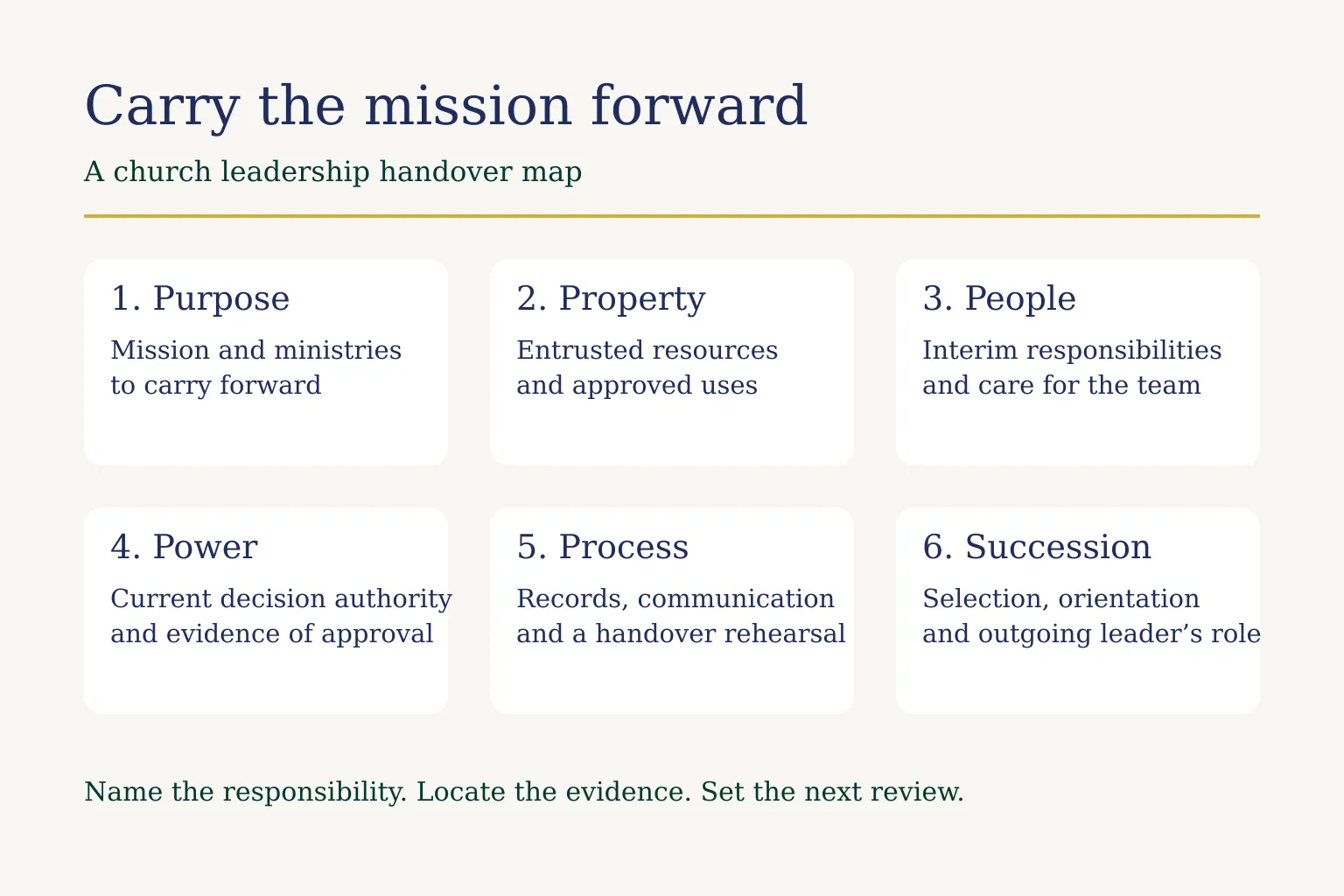
A church succession plan is a written plan for how the mission, responsibilities and leadership will carry forward when a pastor or ministry leader steps aside. It should cover the selection of a successor, interim responsibilities, entrusted resources, current decision authority, records and communication. Start by naming what must continue, then document who is responsible during the transition and what the next leader needs to receive.
What should a church succession plan include?
A church succession plan should connect the leadership change to the work of the ministry. A successor needs more than a title: they need an orientation to the mission, the team, the resources and the decisions already made.
The Episcopal Church Foundation’s Transition Planning guidance, published in May 2016, treats succession as broader than the search for a new rector. It includes financial and facility reviews, staff care, communication, outgoing-leader boundaries and orientation to policies, procedures and meeting minutes. Its setting is Episcopal congregations; use your own church’s governing and denominational requirements for the actual selection and approval process.
Organize the handover under six headings: Purpose → Property → People → Power → Process → Succession.
1. Purpose: name the ministries to carry forward
Write the mission in one sentence, then list the ministries that need attention during the transition. For each, record the next commitment and the person coordinating it. A weekly worship service, youth program and building project may need different transition arrangements.
Ask leaders to distinguish an existing commitment from a proposal. The incoming leader should be able to see what has already been approved and what remains open for discussion.
2. Property: connect entrusted resources to approved uses
List the resources supporting those ministries: funds, facilities, equipment and contracts. Record where ownership records, budgets and any documented use restrictions are kept. Keep ministry resources distinct from the outgoing leader’s personal property.
A resource list should point to the evidence behind an approved use. An account balance alone does not explain which commitments the money supports.
3. People: separate interim work from permanent selection
Name who will coordinate ministry activities, support staff and volunteers, and answer transition questions while selection is underway. Record a backup contact for each responsibility.
For the permanent role, identify who runs the selection process and where the applicable requirements are recorded. Do not assume that the interim coordinator will become the successor or that the founder alone makes the appointment.
4. Power: record who may decide today
For each important decision, locate the current authority and its supporting record. Include spending, contracts, staffing and any other decisions the outgoing leader normally handles. Note unresolved questions for review rather than filling gaps with assumptions.
A planning sheet can describe authority; it does not grant it. Compare the handover notes with the governing documents, recorded approvals and relevant institutional requirements before relying on them.
5. Process: prepare records and communication together
Create an index of the policies, meeting minutes, financial records, contracts and upcoming deadlines the next leader needs. Record the custodian and access process, rather than copying sensitive contents into a widely shared document.
Decide who communicates the transition, which groups hear from that person and when. The congregation may need a clear explanation of the next steps; the person handling payroll needs access appropriate to that responsibility. Keeping those needs separate supports thoughtful privacy.
6. Succession: define the handover and the outgoing role
Write down the selection milestones, orientation responsibilities and first review date. Agree on the outgoing leader’s future involvement before the handover, including how questions will reach the incoming leader.
Leave room for gratitude, prayer and care for both leaders and their families. Operational preparation and a gracious farewell belong in the same transition plan.
Work through one ministry before expanding the plan
Suppose a church’s youth-program leader is stepping aside in six weeks. The program has a venue booking to renew, supplies to order and funds documented for youth activities. The volunteer coordinator knows the schedule but has never approved a contract.
On day one, the transition team records three separate responsibilities:
- The volunteer coordinator prepares the venue-renewal information.
- The treasurer locates the budget, use records and previous approval.
- The governing body checks who may approve the renewal under the church’s current rules.
The team also names who will tell families about the leadership change. Attendance lists and sensitive youth information stay in appropriately controlled records, with access arranged for the incoming responsible person.
By day thirty, the team rehearses the renewal without relying on the outgoing leader to explain each step. If nobody can locate the approval record, the team assigns that gap for resolution before the contract deadline. The rehearsal tests the handover; it does not substitute for an approval.
Watch for a plan that names people but omits decisions
A plan can look complete because every ministry has a contact name. Check whether each contact can find the relevant records, knows the limits of their responsibility and knows where unresolved decisions go.
Other gaps are easy to spot: a successor named without a selection process, a budget with no supporting use records, or an outgoing leader’s role left to informal expectations. Give each gap an owner and a review date. That makes the plan usable without pretending every question is settled.
Organize your ministry handover with Minister Sam
Wealth Cycle System™ offers the Ministry Continuity Blueprint™, a $498 private 75-minute guided working session to organize entrusted resources, approved uses, authority, records and leadership succession. It provides education and a planning map, not property transfers, trust establishment, tax determinations or creation of legal authority; proposed legal, tax and financial changes need review by appropriate licensed professionals.
Your chosen-path workbook follows booking, with preparation review and a written governance map and 30/60/90-day action plan delivered within 48 business hours after the session and receipt of needed information. One round of factual corrections may be requested within five business days of delivery; implementation and new work are separately scoped.
You bring the vision. We organize the structure around it, one clear decision at a time. Explore the Ministry Continuity Blueprint™ with one ministry responsibility you want to carry forward.