Trust Accounting Income vs Principal: The Difference
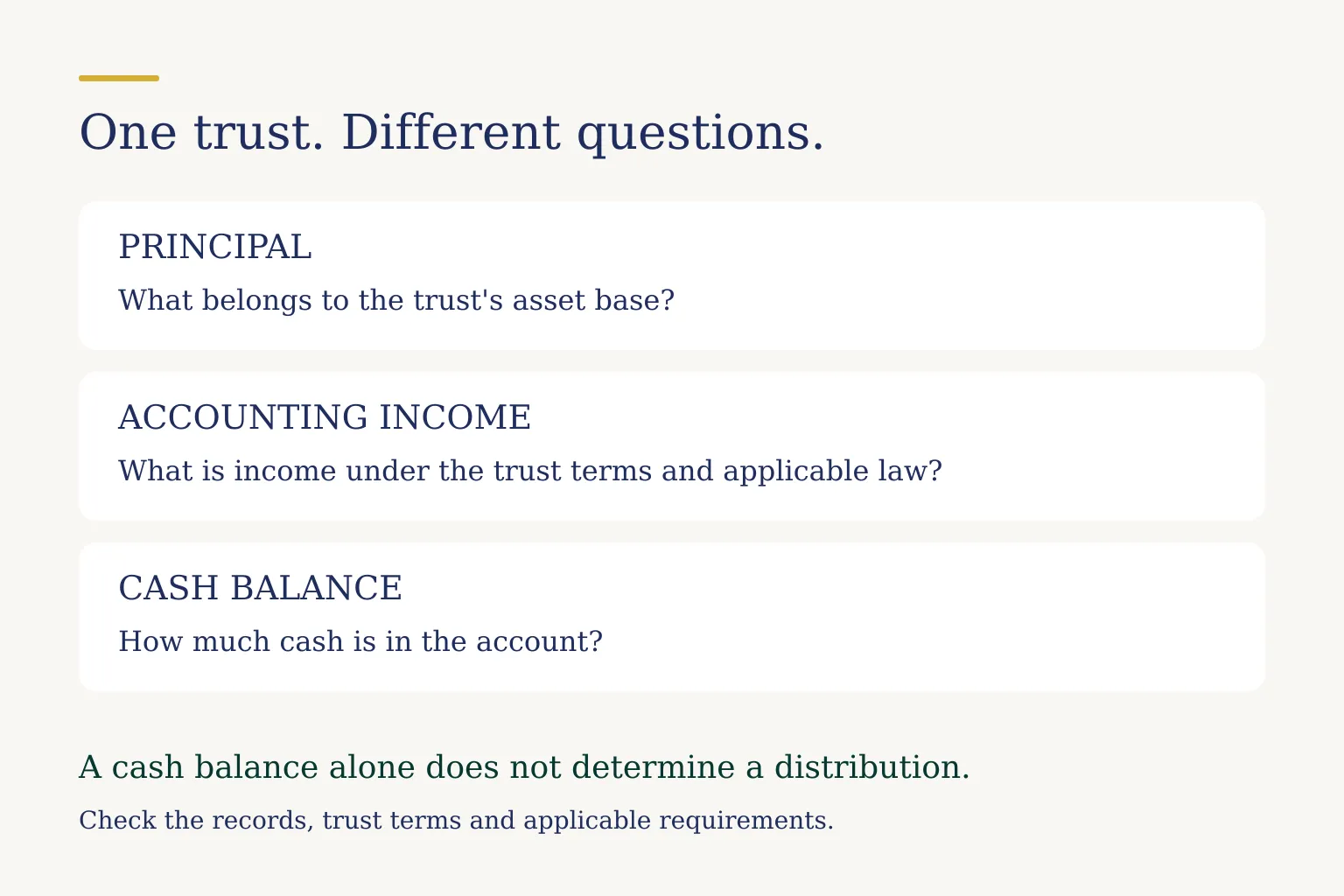
Trust accounting income vs principal is the distinction between a trust’s current return and the property held as its asset base. Cash can belong to either category, so a bank balance does not tell you how much a beneficiary should receive. Classify the receipts and expenses under the trust’s terms and applicable law, then check the distribution requirements separately.
What is trust accounting income vs principal?
Principal is the property held in a trust to support its beneficiaries. Accounting income is the current return from that property, as determined under the trust’s terms and applicable law. Principal can include cash as well as investments or real estate; income is an accounting classification, not simply every deposit into the bank.
For a concrete statutory reference, Virginia Code § 64.2-1033, reviewed in November 2026, defines principal as property held in trust for distribution to, production of income for, or use by a current or successor beneficiary. It defines income as money or other property received as current return from principal, with additional allocation rules for certain receipts. That is Virginia law, not a rule to apply automatically to a trust governed elsewhere.
The IRS’s 2025 Form 1041 instructions likewise tell fiduciaries to figure accounting income under the governing instrument and applicable local law before preparing the return. The trust document and the rules that govern it are the starting point, rather than a label chosen from the bank statement.
Keep four questions separate
| Question | What answers it | What it does not establish |
|---|---|---|
| What is principal? | Asset records and the applicable allocation rules | That principal must stay untouched in every trust |
| What is accounting income? | Receipts and expenses classified under trust terms and applicable law | That every deposit is income |
| How much cash is in the account? | A reconciled bank balance | How much is required or permitted to be distributed |
| How is income reported for tax? | The applicable tax rules and tax preparation records | That a bank transfer and taxable income are the same amount |
A principal balance can change as property is added, sold, distributed or otherwise adjusted. Keeping principal and income distinct is about recording what happened and applying the right rules, not assuming that the original principal amount never changes.
A worked example: $40,600 in cash is not $40,600 of income
Suppose a family trust starts a month with $40,000 in cash recorded as principal. It receives $600 of bank interest during the month, with no other transactions. For this scenario, the trust’s applicable rules have been checked and the interest is allocated to income.
| Transaction | Cash movement | Principal allocation | Income allocation |
|---|---|---|---|
| Opening balance | $40,000 in the account | $40,000 | $0 |
| Bank interest received | $600 added | $0 | $600 |
| Closing balance | $40,600 in the account | $40,000 | $600 |
The bank statement answers the cash question: $40,600 is in the account. The transaction record answers the allocation question: $40,000 is principal and $600 is income in this scenario.
Neither number, by itself, authorizes a payment. Before deciding what to send to a beneficiary, the trustee needs to check the relevant distribution provisions, expenses and other applicable requirements. If an expense appears later, its allocation also needs to be resolved; subtracting it from cash does not automatically tell you whether it reduces income or principal.
On the first day, gather the opening balance and supporting records. At month-end, match each receipt and payment to its evidence and reconcile the closing cash balance. This gives the next person reviewing the trust a trail they can follow rather than one unexplained total.
Record the transaction before deciding what it means
Use a private transaction log with separate fields for the cash movement and accounting allocation. A useful starting format is:
| Field | What to record |
|---|---|
| Date and description | What was received or paid, and when |
| Amount | The actual receipt or payment |
| Supporting record | Statement, receipt, invoice or other evidence location |
| Principal allocation | Amount assigned to principal, once resolved |
| Income allocation | Amount assigned to income, once resolved |
| Basis for allocation | Relevant provision, rule or professional review reference |
| Review status | Resolved, or a named question awaiting review |
If a receipt’s treatment is unclear, preserve the supporting record and flag the question. Guessing now makes the next reconciliation harder. Keep sensitive account details and beneficiary information in appropriately restricted records, rather than a broadly shared planning sheet.
Does delaying a distribution delay the tax?
Delaying a beneficiary payment does not necessarily delay tax. The IRS’s 2025 instructions distinguish accounting income from distributable net income, or DNI, which is used in figuring the income distribution deduction and the amount includible in a beneficiary’s gross income. The instructions also explain that income required to be distributed currently can carry that requirement even when the actual payment occurs after the trust’s tax year ends.
Grantor-type trusts have different reporting rules, also addressed in those instructions. A decision to leave money in an account therefore needs more than a cash-flow explanation: the trust’s tax treatment and distribution obligations matter. Have the appropriate licensed legal and tax professionals resolve those questions for your trust before changing a payment practice.
Watch for these recordkeeping mistakes
- Calling every deposit income. A transfer of existing trust cash between accounts does not, by itself, describe a new return from trust property. Record where the money came from.
- Treating an asset sale as all earnings. Preserve the sale records and acquisition information so the accounting allocation and tax calculation can be reviewed separately.
- Using one combined total. Cash, principal and income answer different questions. A single total conceals the information needed to review them.
- Recording only the payment. Keep the applicable distribution provision and decision record with the supporting information, so someone stepping in can understand the basis for the action.
If someone else will take over the records, identify what they need to receive and where it is kept. For the broader business handoff, the small business continuity plan checklist explains how to organize responsibilities and records access.
Organize the decision and the records around your purpose
Wealth Cycle System™ offers the Wealth Cycle Blueprint™, a $498 private, 75-minute guided working session with Minister Sam to organize business or family resources, people, decision authority and next steps. It provides education and a planning map, not property transfers, trust establishment, tax determinations or creation of legal authority.
The Blueprint includes a chosen-path workbook after booking, preparation review, and a written governance map with a 30/60/90-day action plan within 48 business hours after the session and receipt of needed information. One round of factual corrections may be requested within five business days of delivery; implementation and new work are separately scoped.
Bring one records or responsibility question you want to organize, with technical legal, tax and financial changes reviewed by the appropriate licensed professionals.